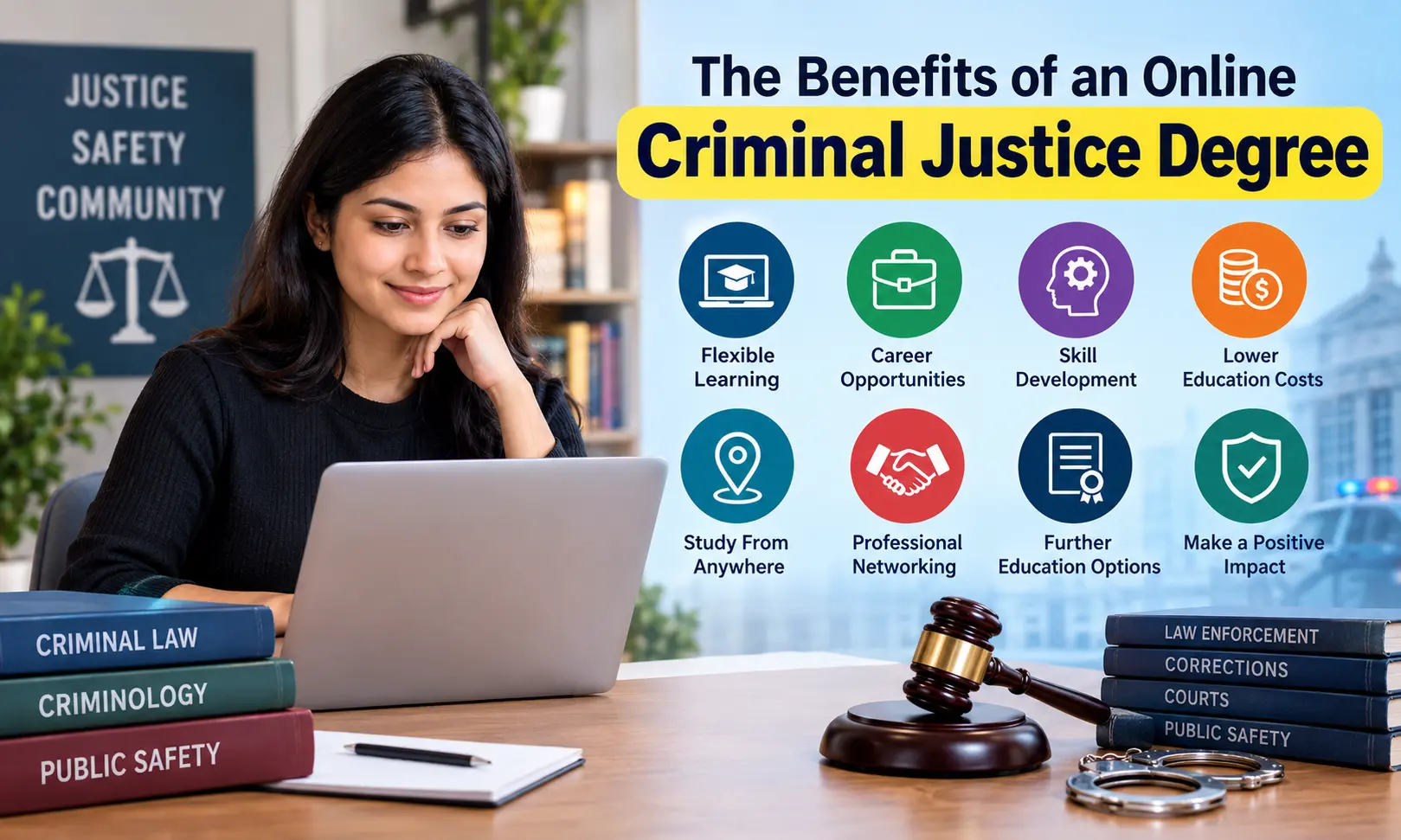
An online criminal justice degree can be an excellent choice for students who want to build a career in law enforcement, corrections, the legal system, or public safety. With the flexibility of online learning, students can pursue higher education while managing work, family responsibilities, and other commitments.
Criminal justice is a broad field that explores how laws are created and enforced, how criminal investigations are conducted, how courts operate, and how correctional systems work. An online degree can help students develop the knowledge, communication skills, critical-thinking abilities, and ethical understanding needed to pursue opportunities in this field.
Whether you are a recent high school graduate, a working professional, or someone considering a career change, studying criminal justice online may offer several important advantages. Let’s explore the key benefits, career opportunities, and factors to consider before enrolling in an online criminal justice program.
1. Flexibility and Convenience
One of the biggest benefits of earning an online criminal justice degree is flexibility. Traditional on-campus programs often require students to attend classes at specific times and locations. Online programs may offer recorded lectures, digital course materials, virtual discussions, and assignments that students can complete according to their schedules.
This flexibility can be particularly valuable for people who work full-time, have family responsibilities, or live far from a college or university.
For example, a working professional may study course materials in the evening, complete assignments during the weekend, and participate in online discussions when convenient. This approach makes higher education more accessible to people with different lifestyles and responsibilities.
However, flexibility varies by institution. Some online programs require scheduled virtual classes, supervised examinations, or in-person practical components, so students should review the format before enrolling.
2. The Opportunity to Balance Work and Education
Many students cannot leave their jobs to attend college full-time. An online criminal justice degree can provide an opportunity to continue earning an income while working toward an academic qualification.
Students may be able to maintain their current employment, manage household expenses, and gain relevant work experience while studying. This can be especially useful for individuals already employed in security, public service, corrections, or administrative positions who want to explore further career opportunities.
Balancing employment and education still requires planning and discipline. Before enrolling, consider the number of weekly study hours required, assignment deadlines, examination schedules, and the flexibility of your employer.
A realistic study plan can help you make consistent progress without neglecting your professional or personal commitments.
3. A Wide Range of Career Opportunities
A criminal justice degree can introduce students to several career paths related to law enforcement, public safety, corrections, investigations, and the legal system. The exact opportunities available depend on the degree level, location, experience, employer requirements, and any additional certifications or examinations.
Some potential career paths include:
- Law enforcement: Explore roles in policing and public safety, subject to the applicable recruitment and training requirements.
- Corrections: Learn about correctional facilities, rehabilitation programs, and the supervision of individuals in custody.
- Probation and parole services: Study rehabilitation, offender supervision, and community-based correctional practices.
- Criminal investigations: Develop foundational knowledge of evidence, investigative procedures, and criminal behavior.
- Victim advocacy: Support victims of crime through appropriate public-service or nonprofit organizations.
- Court administration: Explore administrative and operational work related to courts and legal proceedings.
- Private security: Apply relevant knowledge to security operations, risk management, and loss prevention.
An online criminal justice degree does not automatically qualify graduates for every position. Police, probation, investigative, and government jobs may require specific examinations, physical standards, background checks, professional training, or additional qualifications.
Nevertheless, studying criminal justice can help students understand the field and identify career paths that match their interests and abilities.
4. Develop Critical-Thinking and Analytical Skills
Criminal justice professionals frequently encounter complicated situations that require careful analysis, sound judgment, and attention to detail.
An online criminal justice program may include subjects such as criminal law, criminology, criminal investigations, ethics, and the judicial process. These subjects encourage students to evaluate information, understand different perspectives, and examine how evidence relates to legal procedures.
For example, students may analyze a hypothetical criminal case, examine the reliability of evidence, or discuss how investigators and courts should respond to different circumstances.
These learning experiences can help students develop skills such as:
- Evaluating evidence and information objectively.
- Identifying inconsistencies in reports and statements.
- Understanding legal procedures and criminal behavior.
- Making informed decisions based on available facts.
- Recognizing ethical responsibilities and potential biases.
Such skills may also be useful in professions outside criminal justice, including compliance, security management, public administration, and investigative support.
5. Improve Communication and Report-Writing Skills
Clear communication is essential in criminal justice. Professionals may need to prepare incident reports, document observations, explain procedures, interview individuals, or communicate with colleagues and members of the public.
Online degree programs often involve written assignments, research papers, discussion forums, presentations, and collaborative projects. These activities can help students practice communicating complex information clearly and professionally.
Students may learn to organize arguments, support conclusions with evidence, use appropriate terminology, and distinguish facts from assumptions.
For example, writing a case analysis requires a student to summarize relevant information, identify legal or procedural issues, and explain a conclusion logically.
These skills can be valuable in law enforcement support, court administration, corrections, compliance, and other roles where accurate documentation and professional communication are important.
6. Access to Digital Learning Resources
Online criminal justice programs allow students to access course materials through digital learning platforms. Depending on the institution, these resources may include electronic textbooks, recorded lectures, academic journals, case studies, research databases, and interactive assignments.
Digital resources can make it easier to revisit difficult topics and review lessons before examinations.
For instance, a student studying criminal procedure can replay a recorded lecture, review relevant reading materials, and revisit instructor feedback before completing an assignment.
Online learning can also help students develop digital literacy, research skills, and familiarity with virtual collaboration tools. These abilities may be useful in workplaces that rely on digital records, electronic communication, databases, and information-management systems.
Students should confirm that their chosen institution provides adequate library access, technical support, academic advising, and other resources needed to succeed.
7. Potentially Lower Education Costs
An online criminal justice degree may cost less overall than a traditional campus-based program, although this is not guaranteed. Savings may come from reduced commuting expenses, fewer relocation costs, and the ability to continue working while studying.
Some institutions also offer online tuition rates, financial assistance, payment plans, or scholarships. However, tuition and fees differ considerably among universities.
When comparing programs, look beyond the advertised tuition price. Consider the following expenses:
- Tuition and enrollment fees.
- Digital or physical textbooks.
- Computer equipment and internet access.
- Examination and graduation fees.
- Any required campus visits or practical training.
- Interest or other charges associated with financing education.
A useful way to compare options is to calculate the total estimated cost of completing the entire degree rather than focusing only on the price per course.
Students should also verify accreditation or official recognition, program quality, and whether the qualification meets the requirements of their intended employer. A less expensive program may not be the best value if it does not satisfy relevant professional or educational requirements.
8. Study From Almost Anywhere
Another advantage of online education is that students may be able to study without moving to a different city or country.
This can be especially helpful for learners who live in rural areas, have limited access to nearby universities, or need to remain close to their families or workplaces.
As long as students meet the program’s technical and enrollment requirements, they may be able to access lessons and assignments from home or another suitable location.
Some universities also offer online programs to students in different regions. However, international applicants should verify eligibility, time-zone requirements, language requirements, and any restrictions on distance education.
It is also important to distinguish between earning an academic degree online and completing the practical requirements for a particular job. Some criminal justice careers require local training, licensing, physical assessments, or in-person examinations regardless of where a student earns their degree.
9. Understand the Criminal Justice System
Criminal justice programs can provide a structured introduction to the institutions and processes involved in responding to crime.
Students may learn about the roles of law enforcement agencies, prosecutors, defense attorneys, courts, correctional facilities, and rehabilitation services. They may also explore how criminal laws are applied and how different parts of the justice system interact.
Typical subjects may include:
- Criminology and theories of criminal behavior.
- Criminal law and legal principles.
- Courts and judicial procedures.
- Policing and law enforcement.
- Corrections and rehabilitation.
- Research methods and criminal justice statistics.
- Ethics, civil rights, and professional responsibility.
The specific curriculum depends on the university and country. For example, a program designed around the United States legal system may not directly prepare a student for every legal or government role in India.
Students should therefore choose a program whose curriculum aligns with the legal system and career market in which they intend to work.
10. Explore Criminology and Human Behavior
Understanding why crimes occur is an important area of criminal justice education. Criminology examines patterns of crime and the social, economic, psychological, and environmental factors that may influence criminal behavior.
Students may study how family circumstances, social environments, peer relationships, economic pressures, and other factors relate to offending and victimization.
These subjects can encourage a more informed understanding of crime prevention, rehabilitation, and community safety.
For example, students might compare different approaches to reducing repeat offending or examine how community programs can support rehabilitation.
Criminal justice education does not make every graduate a psychologist or forensic specialist. Those careers may require separate professional qualifications. However, introductory knowledge of human behavior and criminological theories can provide a useful foundation for further study or related work.
11. Learn About Ethics, Rights, and Accountability
Ethics is central to criminal justice because professionals may make decisions that affect individual rights, public safety, and community trust.
An online degree may explore ethical questions involving privacy, evidence collection, the use of authority, fair treatment, confidentiality, and accountability.
Students can learn to consider the legal and ethical implications of professional decisions rather than focusing only on whether an action is operationally effective.
For example, a case study may ask students to consider how investigators should balance the need to gather evidence with legal protections against improper searches or violations of privacy.
Understanding these principles can help students appreciate the importance of fairness, integrity, transparency, and responsible decision-making in criminal justice institutions.
12. Prepare for Further Education
An online criminal justice degree may provide a foundation for advanced academic study. Depending on the qualification earned and the admission requirements of the institution, graduates may consider further education in areas such as criminology, public administration, security studies, forensic science, or related disciplines.
Possible academic pathways include:
- A master’s degree in criminal justice or criminology.
- Postgraduate study in public administration.
- Further study in security or intelligence-related subjects.
- Specialized programs in forensic or investigative fields.
- Research-focused degrees related to crime and public policy.
Admission to these programs is not automatic. Universities may require a relevant bachelor’s degree, minimum grades, entrance examinations, prerequisite subjects, or professional experience.
Students who want to pursue postgraduate study should review the entry requirements of their preferred institutions before selecting an undergraduate program.
13. Build a Foundation for Leadership and Advancement
An online criminal justice degree may help students prepare for positions with greater responsibility, particularly when combined with relevant professional experience.
Some organizations value employees who understand criminal justice procedures, communication, organizational practices, and ethical decision-making. Further education may also help professionals qualify for certain supervisory or administrative opportunities.
Potential areas of advancement include security supervision, correctional administration, public safety coordination, compliance, and criminal justice program management.
However, career advancement depends on more than an academic degree. Employers may consider work experience, professional training, leadership ability, examination results, and other job-specific qualifications.
Students should research the requirements of their target positions to understand whether a degree will support their long-term career plans.
14. Develop Independent Learning and Time-Management Skills
Online learning requires students to take greater responsibility for organizing their studies. Without daily classroom attendance, learners often need to create their own schedules, monitor deadlines, and maintain consistent progress.
These responsibilities can strengthen time-management, organization, and independent learning skills.
A student might divide a large research assignment into smaller tasks, schedule regular study sessions, and use a calendar to track upcoming examinations.
These habits can be useful beyond college. Many professional roles require employees to manage multiple responsibilities, meet deadlines, review information independently, and adapt to changing priorities.
To succeed in an online criminal justice program, students should establish a regular study routine, communicate with instructors when they need help, and avoid leaving assignments until the last minute.
15. Expand Your Professional Network
Although online students may not meet classmates in a traditional classroom, they can still develop professional connections.
Some programs provide virtual discussions, group projects, alumni communities, guest lectures, career services, and online networking opportunities. These activities may allow students to exchange ideas and learn from people with different academic or professional backgrounds.
Students can also explore professional associations, relevant conferences, career events, and internships where available.
Building a professional network may help learners discover career paths, understand employer expectations, and identify opportunities for further training.
However, students should not assume that enrolling in a particular program guarantees internships or employment connections. They should ask the institution about its actual career-support services and placement opportunities.
How to Choose the Right Online Criminal Justice Degree
Selecting the right program is an important step toward achieving your educational and professional goals. Before applying, compare universities carefully and verify that their programs match your needs.
Consider these factors:
| Factor | What to Check |
|---|---|
| Accreditation and recognition | Confirm that the institution and qualification are appropriately recognized. |
| Curriculum | Review subjects, course requirements, and specialization options. |
| Learning format | Check whether classes are self-paced, scheduled, or a combination of both. |
| Total cost | Calculate tuition, fees, books, and other expenses. |
| Faculty support | Check access to instructors, academic advising, and technical assistance. |
| Career services | Ask about career guidance, internships, and employer connections. |
| Admission requirements | Confirm educational prerequisites, language requirements, and deadlines. |
| Career eligibility | Verify whether the qualification meets requirements for your intended job. |
Students in India should pay particular attention to the recognition of the institution and the validity of the qualification for their intended career. If you plan to pursue government employment, check the relevant recruitment notification rather than assuming that an online criminal justice degree will satisfy every eligibility requirement.
Is an Online Criminal Justice Degree Worth It?
An online criminal justice degree can be worthwhile for students who want flexible access to education and a foundation for careers related to law enforcement, corrections, public safety, legal administration, or criminal justice research.
Its value depends on your career goals, the quality of the program, the total cost, and the requirements of employers in your chosen location.
Before enrolling, ask yourself three questions:
- What career do I want to pursue? Identify the positions that interest you and research their education and training requirements.
- Will the degree be recognized? Confirm that the institution and qualification meet the standards relevant to your future plans.
- Can I manage the workload and cost? Review the program schedule, expected study hours, tuition, and additional expenses.
If the program aligns with your goals and offers an appropriate qualification, online learning can be a practical way to develop your knowledge while maintaining other responsibilities.
Frequently Asked Questions (FAQs)
1. Can I earn a criminal justice degree entirely online?
Yes. Some institutions offer fully online criminal justice degrees, while others include scheduled examinations, internships, or in-person requirements. Always confirm the delivery format before applying.
2. What jobs can I pursue with a criminal justice degree?
Depending on your qualifications and local requirements, possible career paths include corrections, law enforcement, court administration, security operations, victim advocacy, and criminal justice research support.
3. Is an online criminal justice degree respected by employers?
Employer acceptance depends on the institution, the recognition of the qualification, the job requirements, and the applicant’s experience. Verify the requirements of your target employer before enrolling.
4. How long does it take to complete an online criminal justice degree?
The duration depends on the degree level, study schedule, transfer credits, and university requirements. A bachelor’s degree commonly takes around three to four years of full-time study, although some programs and education systems differ.
5. Do I need experience before enrolling?
Many entry-level undergraduate programs do not require previous criminal justice experience. However, admission criteria vary, and some postgraduate or specialized programs may require relevant academic or professional experience.
6. Can an online criminal justice degree help me work in law enforcement?
It may help you develop relevant knowledge, but it does not automatically qualify you to become a police officer or law enforcement professional. Recruitment rules, physical standards, examinations, background checks, and training requirements vary by jurisdiction.
7. Is criminal justice the same as criminology?
No. Criminal justice generally focuses on the institutions and processes involved in law enforcement, courts, corrections, and public safety. Criminology focuses more specifically on crime, criminal behavior, its causes, and methods of prevention. The subjects often overlap.
8. Can international students enroll in online criminal justice programs?
Some institutions accept international students, while others impose geographic, residency, or enrollment restrictions. Applicants should verify eligibility, tuition, language requirements, and whether the degree is useful in their intended country of employment.
Conclusion
The benefits of an online criminal justice degree extend beyond convenience. Online study can provide access to educational resources, help students develop analytical and communication skills, introduce them to criminal justice systems, and create a foundation for further education or career exploration.
The flexibility to study while working may also make higher education more accessible to students with professional and family responsibilities.
However, the best program is not necessarily the cheapest or the most flexible. Recognition, curriculum quality, total cost, student support, and career eligibility are equally important considerations.
By researching institutions carefully and connecting your education to realistic career goals, you can make a more informed decision about whether an online criminal justice degree is the right choice for your future.